
What’s lithium battery and lithium-ion battery?
Lithium batteries can be roughly divided into two categories: lithium metal batteries and lithium-ion batteries.
Lithium metal batteries typically use manganese dioxide as the cathode material, metallic lithium or its alloy metals as the anode material, and non-aqueous electrolyte solutions. The discharging reaction is: Li + MnO2 = LiMnO2. Due to its own high technical requirements, only a few companies in several countries are producing this type of battery.
Lithium-ion batteries generally use lithium alloy metal oxides as the cathode material and graphite as the anode material, with a non-aqueous electrolyte. They operate primarily through the movement of lithium ions between the cathode and anode materials. During charging, lithium ions are extracted from the cathode material, travel through the electrolyte, and are inserted into the anode material, placing the anode material in a lithium-rich state while electrical energy is converted into chemical energy for storage. During discharging, the process is reversed, with the stored chemical energy converted back into electrical energy for release. The reaction at the cathode material during charging is: LiCoO2 = Li(1-x)CoO2 + xLi+ + xe–. The reaction at the anode material during charging is: 6C + xLi+ + xe– = LixC6. The overall battery reaction is: LiCoO2 + 6C = Li(1-x)CoO2 + LixC6. Due to their advantages such as high safety, high energy density, long cycle life and low cost, lithium-ion batteries are widely used in various industries.
The commonly used cathode materials for lithium-ion batteries are as follows:
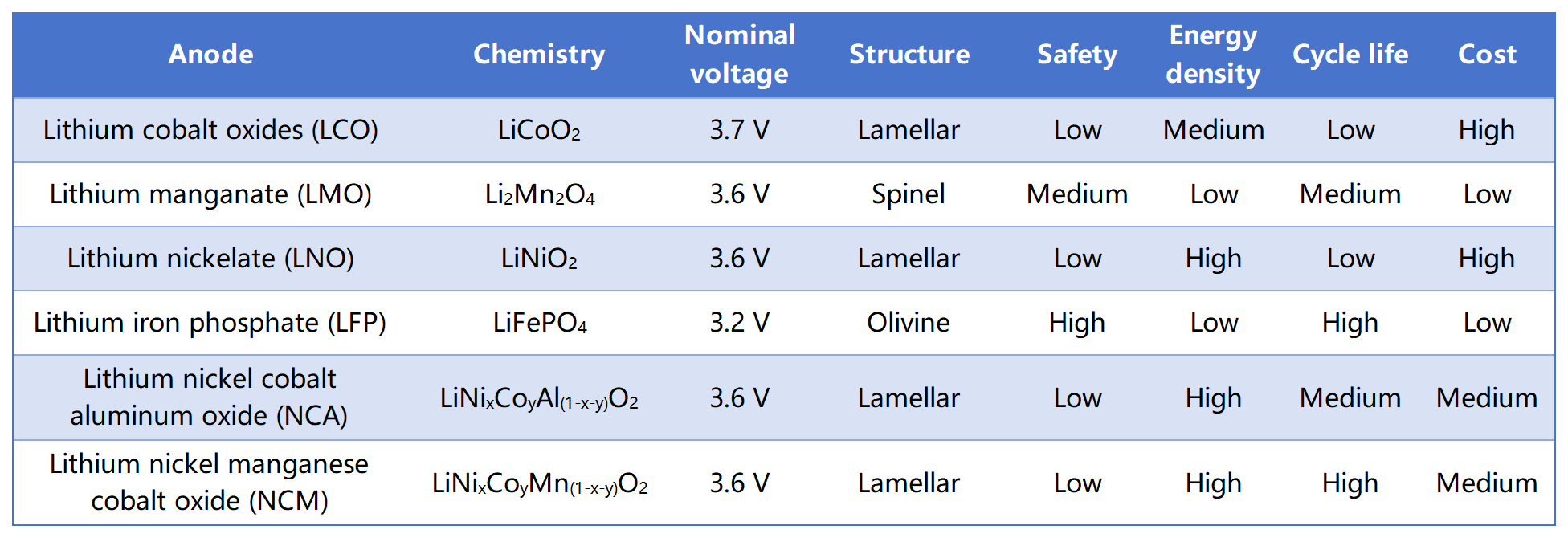
Lithium-ion batteries typically use graphite as the anode material, and lithium metal, lithium alloys, silicon-carbon anodes, and oxides can also be used.
The outer case of lithium-ion batteries generally comes in three types: steel case, aluminum case, and aluminum-plastic film. Steel cases are typically cylindrical, aluminum cases are usually prismatic, and the shape of aluminum-plastic film can be cylindrical, prismatic, or irregular.