
How to Choose the Right Lithium-ion Cell Type?
A Comprehensive Comparison of Cylindrical Steel-case, Prismatic Aluminum-case, and Pouch Cells
When selecting lithium-ion batteries, in addition to battery form factor, the choice of cell type is equally critical.
The main lithium-ion cell types currently available on the market can be broadly classified into three categories: cylindrical steel-case cells, prismatic aluminum-case cells, and pouch cells.
This article provides a detailed comparison of these three cell types from the perspectives of energy density, safety, consistency, system integration, and application scenarios, helping you make a rational and well-informed selection.
1 How to Quickly Choose Among the Three Cell Types?
Before diving into technical details, the following general guidelines may help narrow down your choice:
(1) If you prioritize consistency, automated manufacturing, and system reliability >>> Cylindrical steel-case cells
(2) If you require higher capacity, better structural integration efficiency, and improved space utilization >>> Prismatic aluminum-case cells
(3) If your application places high demands on energy density and lightweight design >>> Pouch cells
Below, we examine each cell type in detail.
2 Cylindrical Steel-case Cells: Best Consistency and the Most Mature Industrialization
2.1 What Are Cylindrical Steel-case Cells?
Cylindrical steel-case cells feature a cylindrical steel case, with internal electrode structures formed through a winding process. Common formats include 18650, 21700, and 4680 cells.
2.2 Advantages of Cylindrical Steel-case Cells
(1) Mature manufacturing process and excellent consistency
> High level of automation
> Good cell-to-cell consistency
> Strong batch-to-batch stability
(2) High mechanical strength and good safety performance
> Steel casing offers strong resistance to impact and compression
> Structural stability remains relatively good even under thermal runaway conditions
(3) Relatively uniform heat dissipation
> Cylindrical geometry facilitates more even heat distribution
> Well suited for high-rate applications
2.3 Disadvantages of Cylindrical Steel-case Cells
(1) Smaller single-cell capacity
> Requires a large number of cells connected in series and parallel
> Leads to higher system structural complexity
(2) Lower space utilization
> Cylindrical geometry creates gaps within battery packs (PACK)
> Volumetric energy density is therefore limited
2.4 Typical Applications
> Electric tools
> Electric bicycles
> Energy storage systems
> Battery systems with high requirements for consistency and reliability
3 Prismatic Aluminum-case Cells: High Structural Integration Efficiency and System-oriented Design
3.1 What Are Prismatic Aluminum-case Cells?
Prismatic aluminum-case cells feature a rectangular aluminum alloy case, with internal electrode structures formed through a winding or stacking process. The single-cell capacities are typically relatively large.
3.2 Advantages of Prismatic Aluminum-case Cells
(1) Large single-cell capacity and high system integration efficiency
> Reduces the amount of series-parallel connection
> Simplifies system structure
(2) High space utilization
> Rectangular shape allows efficient arrangement
> High volumetric utilization at the battery pack (PACK) level
(3) Suitable for customized designs
> Dimensions and voltage platforms can be tailored to specific project requirements
3.3 Disadvantages of Prismatic Aluminum-case Cells
(1) High requirements for consistency and manufacturing yield
> Large single-cell capacity
> Higher demands on manufacturing processes and quality control
(2) More complex thermal management and structural design
> Heat tends to concentrate
> Higher demands on system-level thermal management solutions
3.4 Typical Applications
> Electric vehicles
> Commercial and industrial energy storage
> Large-capacity battery systems
> Applications with high requirements for space utilization and structural integration
4 Pouch Cells: High Energy Density and Clear Lightweight Advantages
4.1 What Are Pouch Cells?
Pouch cells use aluminum-plastic film as the case and are typically manufactured using a stacking process. They offer a high degree of design flexibility.
4.2 Advantages of Pouch Cells
(1) High energy density and low weight
> No pure metal case
> Significant advantage in the specific energy by weight
(2) Flexible design and customizable form factor
> Better flexibility in thickness and dimensions
> Suitable for products with limited installation space
(3) Low internal resistance and good rate capability
4.3 Disadvantages of Pouch Cells
(1) Lower mechanical strength
> Relies on external structural support
> Requires strong PACK-level mechanical design capability
(2) Higher requirements for consistency and process control
> Higher requirements for manufacturing environment and process stability
> Long-term reliability depends heavily on manufacturing quality
4.4 Typical Applications
> Digital products
> Drones
> Lightweight energy storage systems
> Applications with strict requirements for weight and energy density
5 Comparison and Selection
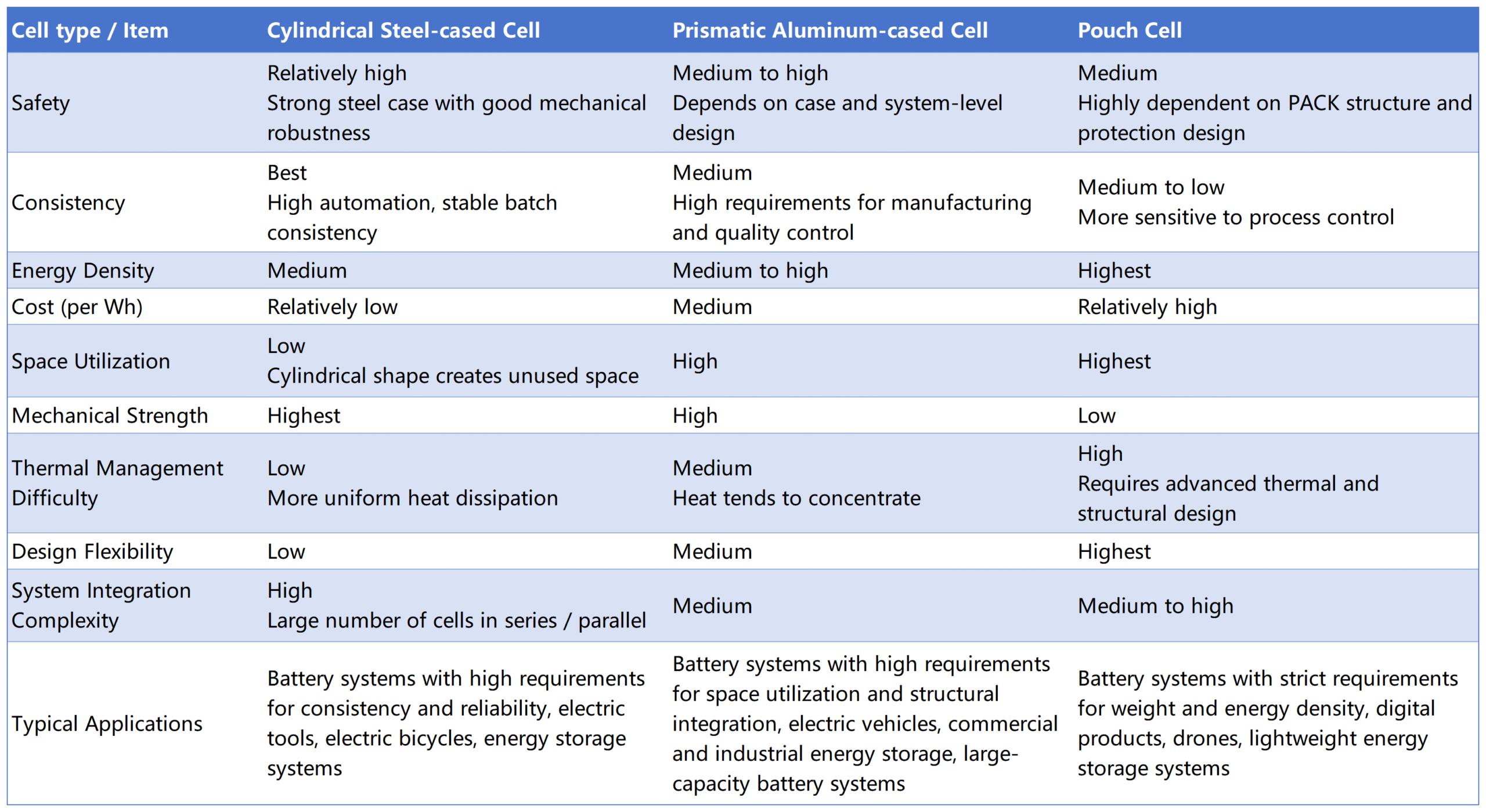
5.1 The advantages and disadvantages of the three types of battery cells are compared as shown in the following figure.
5.2 How to Make a Rational Choice Among the Three Cell Types
5.2.1 Key Questions to Consider
(1) Is the application highly sensitive to weight and volume?
(2) Do you have mature PACK-level structural and thermal management design capabilities?
(3) Do you prioritize system-level consistency or single-cell energy density?
(4) How high are the requirements for safety and long-term reliability in your project?
5.2.2 General Selection Guidelines
(1) Stability and scalability prioritized >>> Cylindrical steel-case cells
(2) Structural efficiency and system integration prioritized >>> Prismatic aluminum-case cells
(3) Energy density and lightweight design prioritized >>> Pouch cells
6 Conclusion
The selection of a lithium-ion cell type is essentially a comprehensive trade-off among manufacturing capability, system design capability, and application requirements. There is no universally optimal cell type and only the solution that best fits your specific application scenario. If you are unsure which cell type is most suitable for your project, feel free to contact us. We will provide professional and objective recommendations based on your specific application requirements.