
How to Choose the Right Lithium-ion Battery Cathode?
A Comprehensive Guide to Common Cathodes
In the design and manufacturing of lithium-ion batteries, the choice of cathode directly impacts the battery’s performance, cost, cycle life, and safety. The cathode is one of the key components of the battery, determining the energy density, charge/discharge efficiency, and thermal stability of the battery. Choosing the right cathode material not only affects battery performance but also influences the final competitiveness of the product.
Currently, there are four commonly used lithium-ion battery cathodes in the market:
> Lithium Cobalt Oxide (LCO, LiCoO2)
> Lithium Iron Phosphate (LFP, LiFePO4)
> Lithium nickel manganese cobalt oxide (NCM, Li(NiCoMn)O2) / Lithium nickel cobalt aluminum oxide (NCA, Li(NiCoAl)O2)
> Lithium Manganese Oxide (LMO, LiMn2O4)
Each cathode has significant differences in energy density, cycle stability, safety, cost, and environmental impact. Therefore, how to choose the appropriate cathode based on practical applications becomes an important decision in battery design and selection.
This article will provide a detailed analysis of the advantages, disadvantages, and applications of these common cathodes and help you make an informed choice based on your specific needs.
1 Overview of Common Lithium-ion Battery Cathodes
1.1 Lithium Cobalt Oxide (LCO)
Lithium cobalt oxide (LCO) is one of the earliest cathode materials used and is still widely used in consumer electronics. LCO has the advantage of high energy density, which enables longer battery life and is widely used in devices such as mobile phones, tablets, and laptops, where size and weight are crucial factors.
1.1.1 Advantages of LCO:
(1) High Energy Density
LCO offers the highest energy density among common cathodes, providing more energy in smaller and lighter batteries. This makes it especially suitable for portable devices with high energy requirements.
(2) Good Cycle Stability
Under normal operating conditions, LCO offers good cycle life, making it suitable for consumer electronics that require frequent charge-discharge cycles.
(3) Mature Technology
LCO has been used for many years, making its technology mature and production process reliable.
1.1.2 Disadvantages of LCO:
(1) High Cost
The price of cobalt is relatively high, which increases the manufacturing cost of LCO batteries, making them more expensive overall.
(2) Poor Thermal Stability
LCO has poor thermal stability, and overcharging or over-discharging can lead to thermal runaway, posing a significant risk in high-temperature environments.
(3) Environmental Impact
Cobalt is relatively scarce and its extraction has a significant environmental impact. Moreover, some cobalt mines are located in regions with limited resources and weak environmental regulation.
1.1.3 Typical Applications:
> High energy density consumer electronics (e.g., mobile phones, tablets, laptops)
> High performance battery systems
1.2 Lithium Iron Phosphate (LFP)
Lithium iron phosphate (LFP) is one of the most favored cathodes due to its excellent safety and long lifespan, especially in electric vehicles and energy storage systems. Compared to lithium cobalt oxide (LCO), it has a lower cost and higher safety.
1.2.1 Advantages of LFP:
(1) Excellent Safety
LFP has outstanding thermal stability, making it highly resistant to thermal runaway and combustion, especially in applications where high safety is required. Its chemical stability is much higher than that of LCO, effectively avoiding risks under overcharge, short-circuit, and other dangerous conditions.
(2) Longer Lifespan
LFP offers an extremely long cycle life, supporting thousands of charge-discharge cycles. It is ideal for long-term applications, such as electric vehicles and large-scale energy storage systems.
(3) Lower Cost
The primary element of LFP is iron, which is much cheaper than cobalt, resulting in lower production costs and a more abundant supply with fewer mining risks.
1.2.2 Disadvantages of LFP:
(1) Lower Energy Density
LFP has a lower energy density compared to LCO and NCM/NCA, which means the battery provides less energy for the same weight and volume.
(2) Poor Low-Temperature Performance
LFP’s performance is weaker in low-temperature environments, and charging or discharging at low temperatures can cause capacity loss.
1.2.3 Typical Applications:
> Electric vehicles, especially those with a tight budget and high safety requirements
> Energy storage systems, especially those intended for long-term use (e.g., home energy storage, wind energy storage)
1.3 Lithium nickel manganese cobalt oxide (NCM) / Lithium nickel cobalt aluminum oxide (NCA)
Lithium nickel manganese cobalt oxide (NCM) and Lithium nickel cobalt aluminum oxide (NCA) are among the most commonly used cathodes in electric vehicles and high-performance batteries. They offer high energy density and good overall performance, making them widely used in electric vehicles and high-end energy storage systems.
1.3.1 Advantages of NCM/NCA:
(1) High Energy Density
NCM and NCA offer high energy density, making them suitable for applications requiring long range, such as electric vehicles and high-end consumer electronics.
(2) Balanced Performance
NCM and NCA materials offer a good balance of energy density, thermal stability, and cost, making them suitable for electric vehicles and energy storage systems.
(3) Longer Cycle Life
With proper design, batteries using NCM/NCA cathodes have a longer cycle life, meeting the demands of long-term use.
1.3.2 Disadvantages of NCM/NCA:
(1) High Cost
Nickel, cobalt, and aluminum are expensive materials, which makes NCM/NCA-based batteries relatively costly.
(2) Relatively Lower Safety
Compared to LFP, NCM/NCA is less safe and could lead to thermal runaway under overcharge or short-circuit conditions.
1.3.3 Typical Applications:
> Electric vehicles, especially long-range models
> High-performance consumer electronics
> Energy storage systems requiring high energy density
1.4 Lithium Manganese Oxide (LMO)
Lithium manganese oxide (LMO) is a cost-effective and safe cathode material that has gained popularity as a low-cost solution, widely used in the mid-to-low-end market. It is commonly used in power tools and certain low-cost energy storage systems.
1.4.1 Advantages of LMO:
(1) Lower Cost
Manganese is an inexpensive and abundant material, making LMO batteries more affordable compared to those based on cobalt or nickel.
(2) Good Safety
LMO offers good thermal stability and is less likely to experience thermal runaway, making it suitable for applications with high safety requirements.
(3) Environmental Friendliness
Manganese is a recyclable resource, and compared to cobalt and nickel, LMO has a much smaller environmental impact.
1.4.2 Disadvantages of LMO:
(1) Lower Energy Density
LMO has lower energy density, which means it is not suitable for high-energy-demand applications, and is better for applications with moderate energy requirements.
(2) Shorter Cycle Life
Compared to LFP and NCM/NCA, LMO has a shorter cycle life, making it suitable for low-power applications rather than long-term, high-demand usage.
1.4.3 Typical Applications:
> Power tools
> Low-cost energy storage systems
> Mid-to-low-end electric vehicles
2 How to Choose the Right Cathode Based on Application
2.1 Comparison of Different Cathode Materials
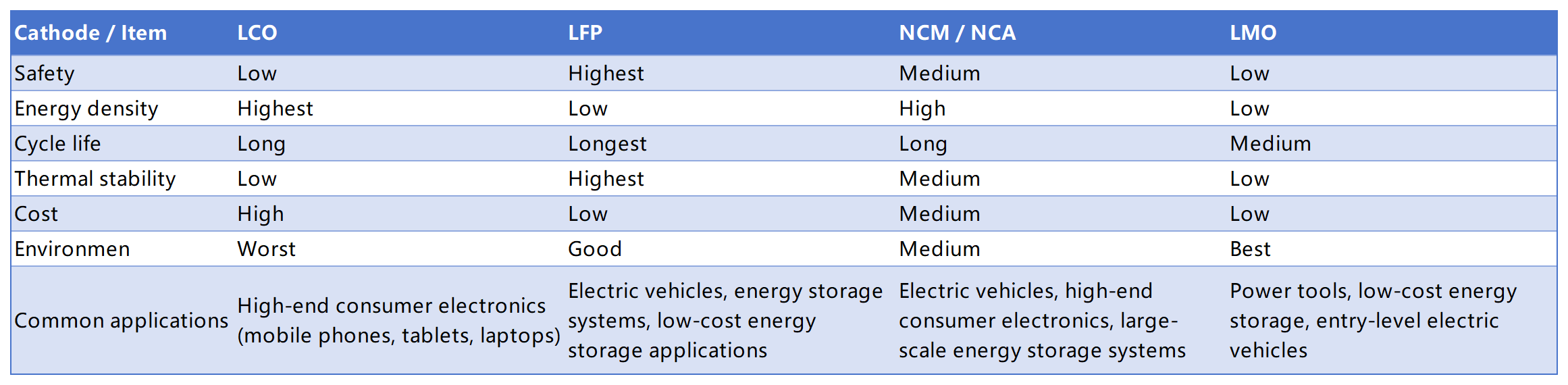
2.2 How to Select the Appropriate Cathode
(1) If you prioritize safety and long lifespan >>> Choose LFP
Suitable for: Electric vehicles, large-scale energy storage systems, and applications requiring high safety and longevity.
(2) If you prioritize energy density and higher performance >>> Choose NCM/NCA
Suitable for: Electric vehicles, high-performance consumer electronics, and applications requiring long-range and energy density.
(3) If you prioritize cost control and moderate performance >>> Choose LMO
Suitable for: Low-cost energy storage devices, power tools, and applications that demand lower cost.
(4) If you prioritize high energy density with moderate safety requirements >>> Choose LCO
Suitable for: High-energy-density consumer electronics, such as mobile phones, tablets, and laptops.
3 Conclusion
The choice of cathode is a key decision in lithium-ion battery design. It requires a comprehensive evaluation of the application needs, performance requirements, and cost control. There is no universally best material, but only the one that best suits your specific application.
If you are still unsure which cathode material is best suited for your project, feel free to contact us. We will provide professional and objective recommendations based on your specific needs.