
Detailed Explanation of Liquid-state, Semi-solid-state, and Solid-state Batteries
Technical Comparison, Advantages, Challenges, and Future Trends
With the growing demand for energy and increasingly stringent environmental requirements, lithium-ion battery technologies have also been advancing. Traditional liquid-state batteries (liquid lithium-ion batteries) are widely used in consumer electronics, electric vehicles, and energy storage systems. However, with the increasing demand for higher energy density, longer lifespan, and improved safety, semi-solid-state and solid-state battery technologies have become the focus of research.
This article will explore the working principles, performance, advantages, challenges, and future development trends of liquid-state, semi-solid-state, and solid-state batteries. It will also help you understand the differences between the three and their respective applications.
1 Liquid-state Battery
1.1 Working Principle
Liquid-state batteries, typically referring to liquid electrolyte lithium-ion batteries, have a basic structure consisting of a cathode, an anode, and a liquid electrolyte. The electrolyte serves as a conductor for lithium ions, playing a crucial role during the charging and discharging process. The working principle of a liquid battery involves energy storage and release through reactions at the electrodes, with lithium ions moving through the liquid electrolyte between the cathodes and anodes, completing the energy conversion.
1.2 Advantages and Features
1.2.1 Mature Technology
Liquid lithium batteries are the most mature battery technology today, widely used in consumer electronics, energy storage devices, and electric vehicles.
1.2.2 High Energy Density
Liquid-state batteries offer high energy density, especially for electric vehicles and portable devices, providing longer usage times and extended range.
1.2.3 Relatively Low Production Costs
The production process for liquid-state batteries is well-established, and the supply chain for raw materials is mature, making the production costs relatively low.
1.3 Disadvantages and Challenges
1.3.1 Safety Issues
The liquid electrolyte in liquid-state batteries presents a thermal runaway risk, especially under high temperature or overcharging conditions, where the battery may catch fire or explode.
1.3.2 Bad Low-Temperature Performance
Liquid-state batteries experience a rapid performance decline in low-temperature environments. For instance, in cold regions like the Arctic, the battery’s energy output and lifespan are significantly affected.
1.3.3 Limited Cycle Life
The electrolyte in liquid-state batteries degrades over time, affecting the battery’s lifespan. The degradation of the electrolyte and internal reactions reduce the number of charge-discharge cycles.
1.4 Common Applications
> Consumer electronics: such as mobile phones, laptops, tablets, etc.
> Electric vehicles: especially mid-to-high-end electric vehicles.
> Renewable energy storage systems: such as solar and wind energy storage.
2 Semi-solid-state Battery
2.1 Working Principle
Semi-solid-state batteries combine the advantages of liquid-state and solid-state batteries. They use a semi-solid electrolyte, which has a higher viscosity than the liquid electrolyte but is not completely solidified. The working principle is similar to that of liquid-state batteries, with the electrolyte conducting electricity between the cathodes and anodes. However, due to the higher viscosity of the electrolyte, semi-solid-state batteries provide improved safety and energy density.
2.2 Advantages and Features
2.2.1 Higher Safety
Compared to liquid-state batteries, semi-solid-state batteries offer improved safety, particularly under overcharging or high-temperature conditions. The higher viscosity of the electrolyte reduces the flow and lowers the risk of thermal runaway.
2.2.2 Higher Energy Density
Semi-solid-state batteries can offer higher energy density than liquid-state batteries, making them suitable for applications that require long endurance.
2.2.3 Better Low-Temperature Performance
Compared to liquid-state batteries, semi-solid-state batteries experience less performance decline in cold environments, making them more suitable for use in colder climates.
2.3 Disadvantages and Challenges
2.3.1 Complex Manufacturing Process
The manufacturing process for semi-solid-state batteries is more complex. Precise control of the electrolyte’s viscosity and the battery structure is required, which increases production costs.
2.3.2 Electrolyte Material Issues
Current semi-solid-state batteries still face challenges in selecting suitable electrolyte materials. Improving the conductivity and stability of the electrolyte remains a key technological hurdle.
2.3.3 Limited Commercialization
Although semi-solid-state batteries show high potential, their technology is still developing, and they have not yet been widely adopted in mainstream consumer markets.
2.4 Common Applications
> Electric vehicles: especially those requiring higher safety and energy density.
> Wearable devices: for consumer electronics that require higher energy density and safety.
> Large-scale energy storage: for applications that require longer lifespan and stability.
3 Solid-state Battery
3.1 Working Principle
Solid-state batteries represent a revolutionary development in future battery technologies. Unlike liquid-state and semi-solid-state batteries, solid-state batteries use solid electrolytes instead of traditional liquid electrolytes, significantly improving the battery’s safety and energy density. The working principle is similar to traditional lithium-ion batteries, but the electrolyte and electrodes are solid materials, offering better conductivity and greater chemical stability.
3.2 Advantages and Features
3.2.1 Extremely High Safety
Solid-state batteries do not use liquid electrolytes, thus eliminating the risk of thermal runaway. Even under extreme conditions like high temperature, overcharging, or short-circuiting, solid-state batteries are safer than liquid and semi-solid-state batteries.
3.2.2 Higher Energy Density
Solid-state batteries offer significantly higher energy density than both liquid-state and semi-solid-state batteries. This means that, for the same volume or weight, solid-state batteries can store more energy, making them ideal for electric vehicles and high-energy-density applications.
3.2.3 Longer Lifespan
The solid electrolyte does not degrade or leak over time, which significantly extends the battery’s lifespan and the number of charge-discharge cycles.
3.3 Disadvantages and Challenges
3.3.1 Technical Challenges
The technology of solid-state batteries is still in the development phase. Issues such as electrolyte conductivity, mechanical strength, and compatibility with electrodes have not yet been fully solved. Achieving large-scale production and commercialization will take time.
3.3.2 High Cost
Solid-state batteries involve more complex materials and manufacturing processes, making their production costs significantly higher than traditional liquid and semi-solid-state batteries.
3.3.3 Material Issues
Although solid-state batteries hold great potential, the current solid electrolyte materials face challenges such as poor conductivity and high cost. Researchers are continually working to improve the materials to enhance performance.
3.4 Common Applications
> Electric vehicles: solid-state batteries’ high energy density and long lifespan make them ideal for electric vehicles, especially models requiring high range and safety.
> High-end consumer electronics: such as mobile phones, laptops, etc., where solid-state batteries offer longer battery life and safer operation.
> Energy storage systems: solid-state batteries in large-scale energy storage systems can provide higher energy density and longer lifespan, making them suitable for renewable energy storage.
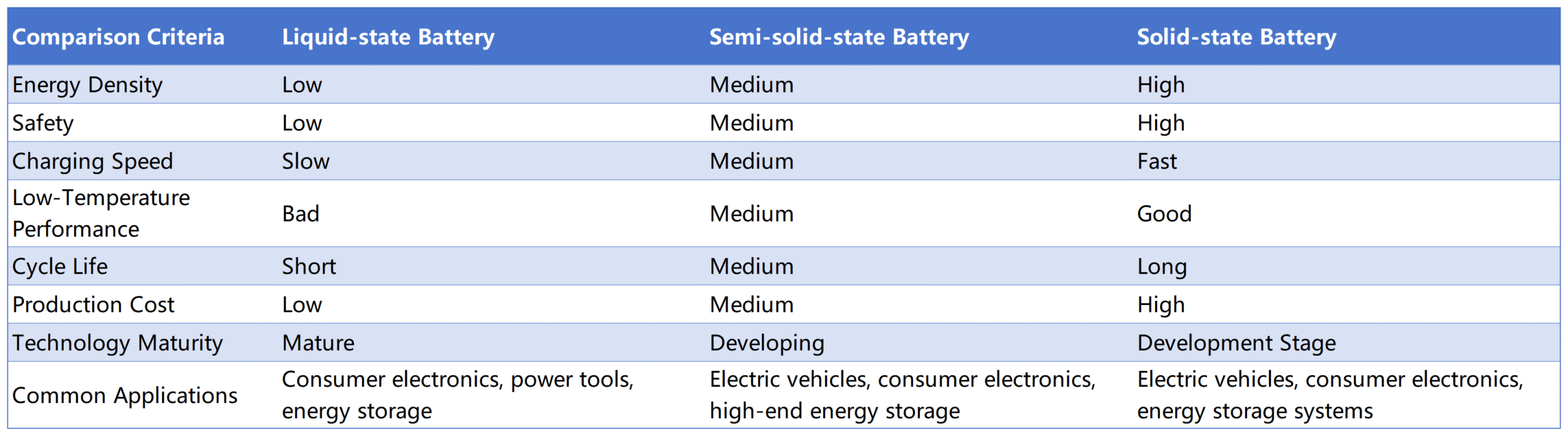
4 Comparison of Liquid-state, Semi-solid-state, and Solid-state Batteries
5 Conclusion
Liquid-state batteries, semi-solid-state batteries, and solid-state batteries each offer distinct technical advantages and future potential. When choosing the appropriate battery technology, it’s essential to consider factors such as energy density requirements, safety needs, charging speed, and lifecycle expectations.
Currently, liquid-state batteries remain the most mature and widely used technology, while semi-solid-state and solid-state batteries represent the future direction of battery technology. Particularly in applications that require high safety, high energy density, and long lifespan, solid-state batteries hold tremendous potential.
With continued technological advancements, solid-state batteries are expected to be commercialized in the coming years, playing a critical role in electric vehicles, energy storage systems, and other high-end applications. If you have any questions about battery technology, feel free to contact us, and we will provide professional answers.