
How to Choose the Right Lithium-ion Battery Form Factor?
A Comprehensive Guide to Cells, Modules, and Battery Packs (PACK)
When selecting lithium-ion batteries, many customers focus on capacity, voltage, and cycle life, while overlooking an equally critical factor: the battery form factor.
From both manufacturing and application perspectives, lithium-ion batteries are typically available in three forms: cells, modules, and battery packs (PACK). Each form differs significantly in technical requirements, system integration complexity, cost structure, and risk allocation.
In this article, we analyze the advantages and disadvantages of each battery form factor from the perspectives of cost, safety, integration complexity, and application scenarios, helping you choose the most suitable solution for your project.
1 How to Quickly Choose Among the Three Battery Form Factors?
(1) If you have a mature battery R&D or system integration capability >>> Cells
(2) If you have some battery engineering expertise but prefer not to start from scratch >>> Modules
(3) If you prioritize delivery reliability, system safety, and fast project deployment >>> Battery pack (PACK)
Below, we examine each cell type in detail.
2 Cells: The Most Fundamental, Flexible, and Challenging Option
2.1 What Is a Battery Cell?
A battery cell is the smallest functional unit of a lithium-ion battery. It contains the cathode, anode, electrolyte, separator, case, etc. Common formats include cylindrical steel case cells, prismatic aluminum case cells, and pouch cells.
2.2 Advantages of Battery Cells
(1) Lowest cost per unit of energy
Since cells do not include structural components, a battery management system (BMS), or enclosure, they offer the lowest cost per watt-hour.
(2) Maximum design flexibility
Series and parallel configurations can be freely designed according to application requirements, making cells ideal for highly customized systems.
(3) Suitable for large-scale production and secondary development
Cells are especially attractive to large battery system integrators and manufacturers with in-house engineering capabilities.
2.3 Disadvantages of Battery Cells
(1) Extremely high technical requirements
The buyer must independently design the mechanical structure, BMS, thermal management system, and safety protection mechanisms.
(2) Safety risks are borne by the buyer
Cells do not provide complete protection by themselves. Improper system design can significantly increase the risk of thermal runaway.
(3) Long development cycles and high trial-and-error costs
As the most basic unit, cells require integration with structural components, BMS, thermal management, and safety systems to form a fully functional battery system for real-world applications.
2.4 Typical Applications for Cells
Battery system integrators, energy storage system manufacturers, OEM/ODM companies with mature battery engineering teams, and large-scale customized projects.
3 Modules: A More Engineered Semi-Finished Solution
3.1 What Is a Battery Module?
A battery module is an intermediate form consisting of multiple cells connected in series and/or parallel. It typically includes cell assemblies, basic mechanical support, and simple voltage and temperature sensing components.
3.2 Advantages of Battery Modules
(1) Higher level of engineering than cells
Cell grouping and basic structural design are already completed, reducing system integration complexity.
(2) Better consistency and reliability
Cells are matched and screened, resulting in more stable performance.
(3) A balanced solution between cost and safety
Compared with cells, modules offer improved system safety and consistency; compared with battery packs, they feature lower cost and reduced structural complexity.
3.3 Disadvantages of Battery Modules
(1) Lower flexibility compared to cells
Series and parallel configurations are limited, and available specifications are fewer.
(2) Still requires system-level design capabilities
PACK-level mechanical design, a full BMS, and thermal management system are still required.
3.4 Typical Applications for Modules
Industrial equipment, commercial energy storage systems, mid-sized electric vehicles, and companies with some battery engineering capability that prefer not to start from the cell level.
4 Battery Packs (PACK): The Most Delivery-Friendly and Lowest-Risk Solution
4.1 What Is a Battery Pack (PACK)?
A battery pack (PACK) is a complete, ready-to-use battery system. It typically integrates cells or modules, a BMS (Battery Management System), mechanical enclosure, thermal management system, and protection and communication interfaces, allowing direct integration into end-use equipment.
4.2 Advantages of Battery Packs
(1) Ready for deployment with the shortest development cycle
No battery system design is required, making PACKs ideal for projects with tight timelines.
(2) Highest level of system safety
PACKs undergo system-level testing and include protections against overcharge, over-discharge, short circuits, and over-temperature.
(3) Clear responsibility boundaries
System performance and safety are the supplier’s responsibility, significantly reducing project risk for the buyer.
4.3 Disadvantages of Battery Packs
(1) Highest cost per unit of energy
Costs include mechanical structures, electronics, electrical components, and testing.
(2) Relatively limited customization flexibility
Dimensions, voltage levels, and interfaces are often standardized; deep customization usually requires minimum order quantities (MOQ).
4.4 Typical Applications for Battery Packs
Commercial and industrial energy storage, medical devices, telecom base stations, robots and AGVs, and end-equipment manufacturers without in-house battery expertise.
5 Comparison and Selection
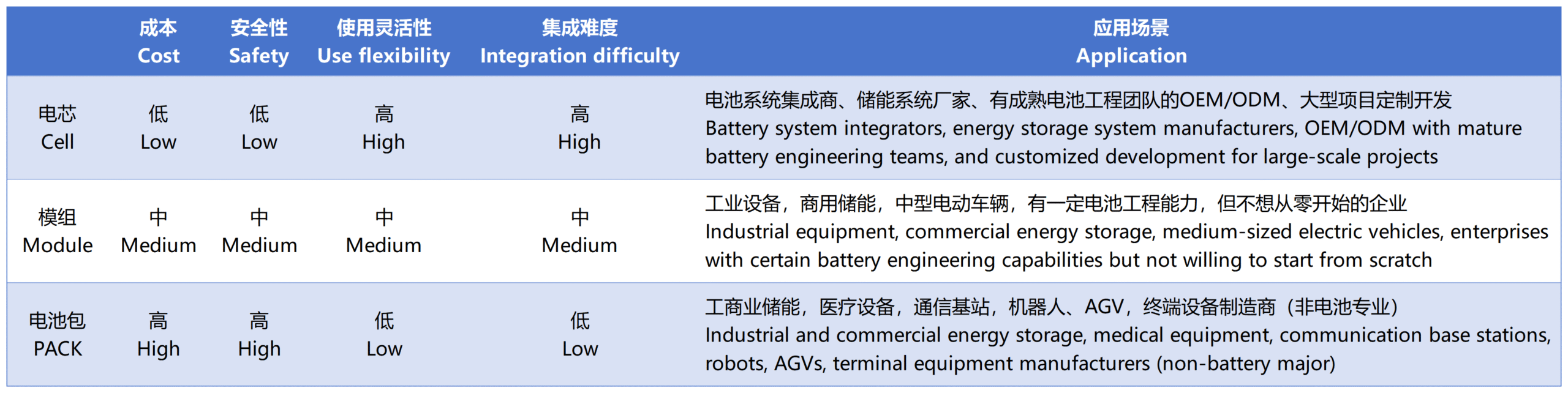
5.1 The advantages and disadvantages of the three battery form factors are compared as shown in the following figure.
5.2 How to Make a Rational Choice Among the Three Options
5.2.1 You may consider the following questions:
(1) Do you have in-house battery system design capabilities?
(2) Does your project prioritize cost, or safety and delivery speed?
(3) Is a high degree of customization required?
(4) What level of risk tolerance does the project allow in case of failure or safety incidents?
5.2.2 General Selection Guidelines
The closer the battery is to the end application, the more suitable a battery pack (PACK) becomes. The closer it is to the upstream of the battery industry chain, the more suitable battery cells are. Modules represent a balanced option in between.
6 Conclusion
Choosing a lithium-ion battery form factor is essentially a trade-off among cost, flexibility, safety, and engineering capability. There is no universally better option and only the one that best fits your specific application.
If you are still uncertain which battery form factor is most suitable for your requirements, feel free to contact us. We will provide objective and professional recommendations for free based on your application scenario, regardless of whether you eventually choose to cooperate with us or not.